Radios tied to the vehicle
Crews lose contact once they leave the ambulance.
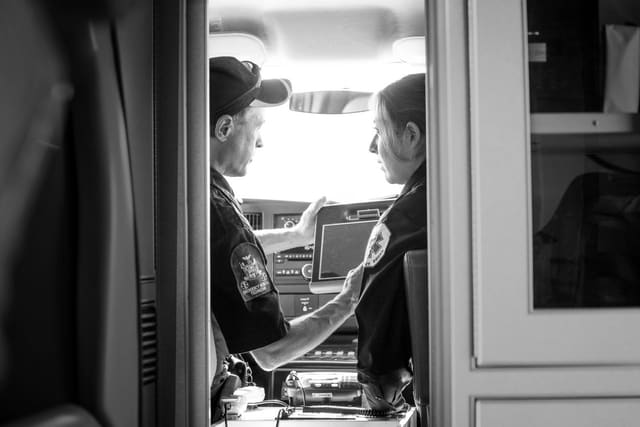
Keep ambulance crews and the control room connected across the response area.
Overview
Ambulance crews need to reach the control room in seconds, whether they are in the vehicle, at the scene or in a hospital corridor. Mission-critical push-to-talk on a rugged phone gives them instant, priority communication with location attached to every call.
EMS communication often depends on vehicle radios that only work in the cab, handheld radios with patchy coverage, and personal phones for everything else. Crews struggle to reach the control room from inside buildings or rural areas, and controllers cannot see where a crew is when they call. Important updates, such as a change in patient condition or a request for backup, are delayed. Push-to-talk over cellular and Wi-Fi works wherever there is network coverage and can connect to existing radio networks, so crews and controllers stay connected across the whole response.
A crew is treating a patient in a third-floor flat when the patient's condition deteriorates. The paramedic presses the emergency priority button on their rugged phone, interrupting other traffic to reach the controller immediately with location attached. The controller dispatches an advanced life support unit and updates the receiving hospital. While transporting, the crew sends a photo of the ECG to the hospital team through the same app. Every call and message is recorded against the incident for clinical review.
The challenge
Crews lose contact once they leave the ambulance.
Handheld radios struggle inside buildings and in rural areas.
Controllers do not know exactly where the crew is calling from.
Updates made by personal phone are not captured for review.
Operational flow
01
Give each crew member a rugged phone with push-to-talk.
02
Join crews to talk groups for their area, station and incident.
03
Emergency and priority calls override routine traffic.
04
Send messages, photos and location to the control room and hospitals.
05
All calls and messages are logged for clinical and operational review.
What operations can see
Operational impact
Who it's for
Keep crews and controllers connected through every call.
Coordinate teams across large venues and events.
Stay in contact with receiving facilities during transport.
See crew locations and manage priority traffic.
Insight
Push-to-talk keeps ambulance crews connected wherever the call takes them. Priority calls get through when it matters, controllers see where crews are, and every update is recorded. Patient handovers improve because information arrives before the vehicle does.
This use case is particularly relevant to EMS environments, but the underlying operating model can also apply wherever distributed frontline teams, vehicles, assets or facilities need stronger visibility and accountability.
FAQ
For many services it can, or it can work alongside existing radios. Push-to-talk over cellular gives wider coverage and can connect to radio networks, so both systems work together.
Priority calling lets emergency or supervisor calls override routine traffic, so urgent messages are heard immediately.
Yes. Push-to-talk apps support messaging, photos and location sharing alongside voice.
Yes. Calls and messages can be recorded and stored for clinical review, investigation and compliance.

Tell us how your operation runs today and we'll show you what this looks like for your teams.